As people scrutinize candidates’ policy proposals ahead of the November local government elections, some people in Taipei are calling for more attention for the city’s homeless community.
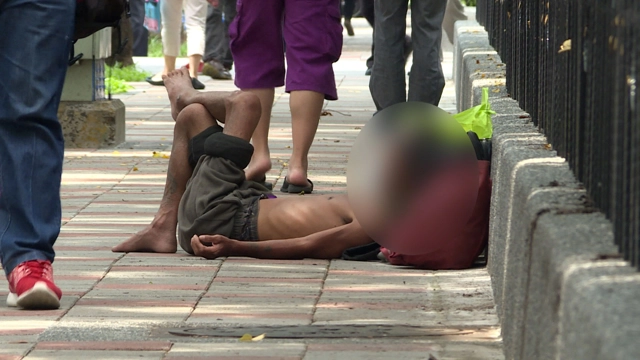
This man, who goes by Hsiao Pang, has been sleeping rough in Taipei’s Wanhua District for the past three years. His leg was severely injured during his previous job... forcing him to quit. After spending all his government compensation and with no income... he was forced out of his home.
HSIAO PANG, HOMELESS INDIVIDUAL:
"The police said local residents think there are too many homeless people in Wanhua and want us gone. But If we had a home to go back to who would choose to live on the streets? I hope the government can provide subsidies so that we have a chance to rent a place and can create more job opportunities so that people like me, who have difficulty finding work can have a chance to earn a living."
And he’s not alone. At this local park that he calls home... many people also find themselves stuck on the streets.
Here at Wanhua’s Bangka park, a homeless community has been gathering for decades… sustaining a support system with food and jobs for one another. But with park under construction and set to reopen on Oct 17th, many worry that they won't be able to stay there and have nowhere else to go.
Some of them told TaiwanPlus that the past year of park construction has forced them to sleep on the pavement or roads.
And while charity groups still come from time to time to hand out food... A few of their friends have left the area.
TAIPEI RESIDENT 1:
"There are fewer people. Some have left, and some haven’t. Some people have gotten used to coming here. They just can’t help but come back. It’s become a habit. [The Department of Social Welfare] will help somehow such as low-income application or finding a place to stay."
Some nearby residents have their fair share of grievances, but admit there’s no easy solution.
LAN HSIU-LUAN, NEIGHBORHOOD CHIEF:
"It’s not that we’ve gotten used to it. We don’t want to get used to it, either. Sometimes we see them arguing and shouting at each other. I think even if you're not used to it you have to get used to it because there's no way to solve the problem. I think there should be some regulation. In the future, people shouldn't be allowed to hand out food here. If people want food they should go to a designated location."
Several NGOs supporting the homeless population urge the government to offer better ways to help them change their lives... instead of just forcing them to leave.
This advocacy group is setting an example by offering free bathing and consulting services.
CHANG KAI-CHUN, HOMELESS TAIWAN ASSOC.:
"We do outreach visits to homeless people throughout the district. We check in on those we already know and see how they’ve been doing. We also invite them to come to our bathhouse to take a shower. When we meet someone who is newly homeless we give them a map and show them how to get to our facility to wash up. Some people tell me they want to rent a place to live. Others want to find a job. Some hope to return home and reconnect with their families. Depending on their needs, we provide different forms of assistance and support."
Homeless people in Taiwan often don’t meet the government criteria for low-income status ... because the law also counts their immediate families’ assets... even though many living on the streets aren’t supported by them.
NGOs here point to a functional model used by Japan.
WANG CHIN-WEI, HOMELESS TAIWAN ASSOC.:
"In Japan, support is provided through the public assistance system and legislation for helping homeless people achieve self-reliance. [Japan’s social workers] will engage with homeless individuals and offer monthly subsidies that cover housing and living expenses. They also provide one-stop services including health care, employment, life coaching and psychological counseling. In Taiwan, even the most basic social welfare system is letting homeless people fall through the cracks."
The health ministry is looking into streamlining the low-income status application process.
With these systemic problems still in the way... and unfriendly treatment on the streets... It’s a long road for homeless people in the capital to rebuild their lives.
 03:37
03:37 00:31
00:31 00:36
00:36 01:55
01:55 02:29
02:29 02:40
02:40 00:32
00:32 02:02
02:02 01:54
01:54 02:09
02:09 00:50
00:50 00:50
00:50 01:11
01:11 00:40
00:40 00:26
00:26 00:23
00:23