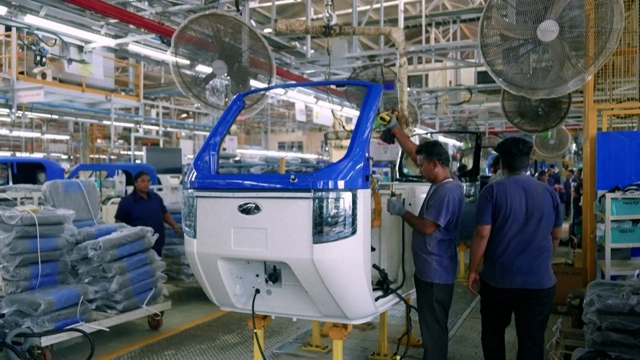
Rickshaws are a way of life in India, weaving through the chaotic streets of the world’s most populous country. Now, its three-wheelers are rapidly going electric and the thump of the traditional “tuk-tuk” is fading.
More than half of all new three-wheelers sold in India are electric, compared with about 8.5% of cars and 11.6% of two-wheel vehicles. It’s been a windfall for manufacturers.
SUMAN MISHRA, CHIEF EXECUTIVE MAHINDRA LAST MILE MOBILITY:
"Our company has grown six times in its EV penetration in the last five years. Yes, we were surprised by it. Electrification is now close to 50% and I hope that it will be 75-80% by 2030."
Drivers are cashing in too. They say lower running costs more than justify the higher upfront price.
AFROZ ALAM, AUTO RICKSHAW DRIVER:
"I’ve been running it for six months now. It’s really great and was worth buying. It’s actually bringing money into my pocket."
Economics is driving the shift. Experts estimate gas-powered three-wheelers cost more than twice as much per kilometer to run over their lifetime. That’s a big draw for a country that relies on fuel imports and has felt recent price surges. Government subsidies help soften the upfront cost, too.
But hurdles remain. Adoption is uneven, held back by a lack of infrastructure. EV makers say charging is a major bottleneck in dense cities like Mumbai, where drivers without dedicated parking struggle to find a place to plug in.
Questions also linger over safety. Some drivers worry these lightweight vehicles offer little protection in a crash.
MUZAHIDUL, AUTO RICKSHAW DRIVER:
"There’s no safety at all. It only has this tiny little jerkin-type cover, so if it hits you, you’re done for. There’s no safety in it."
The industry also depends on imported battery cells and key components. The Indian government is pushing domestic manufacturing but still leans heavily on China and South Korea. And New Delhi’s cooling ties with Beijing, a major supplier of the rare earths used in EV motors, could complicate things further. All bottlenecks to be overcome as the push for electric vehicles gains momentum.
Justin Wu and Ted Chen for TaiwanPlus.
 02:31
 04:31
 03:06
 00:25
 02:36
 02:00
 02:13
 02:02
 02:42
 00:27
 03:15
 02:07
 02:40
 03:25
 01:59
 00:54