This island to the north of Manila is using a different kind of sea defense.
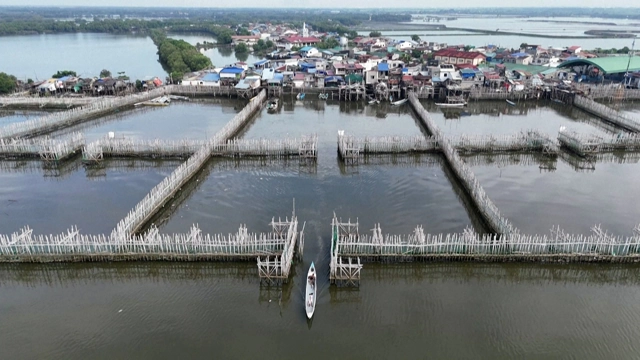
Here on Pamarawan Island, nature-based solutions are succeeding where conventional methods of flood control have failed local residents.
EDGAR JAVIER, FISHER:
"We were terrified whenever there were typhoons. We couldn't sleep at night, especially when they're accompanied by thunder and lightning."
... The new approach, using bamboo sediment traps and breakwaters made of coconut fiber nets and oyster shells, seems to be winning people over.
ARSENIA CABIGAO, RESIDENT:
"Our feet are dry at last. They weren't before, when this project hadn’t been built yet. Now that they've also built the road here, we are able to stand on dry ground. It's a huge help."
This project is the first of its kind in the Philippines.
And some expect it could prove popular in a country where there’s been a multi-billion-dollar scandal over substandard concrete-based projects.
These nature-based solutions are also expected to cost less than concrete seawalls.
CHRISTIAN NATIVIDAD, MAYOR OF MALOLOS CITY:
"We should not fight nature and we should rebuild with nature. And this is just one single thing, a very small project that hopefully can spark the new hope for rebuilding our nature, not only for in the Philippines but in the whole world."
It’s still early days, though, and the project’s effectiveness isn’t certain yet. Bamboo releases carbon as it decomposes, and defenses may need replacing every five years. Some see the project on Pamawaran Island as far from a finished solution.
ANTONIO CONTRERAS, UNIVERSITY OF THE PHILIPPINES:
"There must be a scientific assessment done by the innovators of this and we'll see. But right now I think we should look at it from the perspective of an innovation that is interesting and promising."
But an assessment is coming next year that will see if the next phase of the project—planting protective mangroves—can go ahead. Those behind this project are optimistic.
LYANA GALANG, PROJECT MANAGER:
"This project is to build a long-term flood mitigation and wave impact solution. Now, because of this, the impact of the waves is lessened. Sediments are also beginning to accumulate because of the sediment-trapping units, which collect sediment in order to rebuild the shoreline."
The fury of the sea in this part of the world isn't going away. But if the project proves successful, the idea of using nature to hold back nature could make waves in how we protect our coastlines.
John Su and John Van Trieste for TaiwanPlus.
 02:42
 00:27
 03:15
 02:07
 02:40
 03:25
 01:59
 00:54
 02:26
 02:43
 00:37
 00:48
 03:06
 04:09
 00:32
 03:29