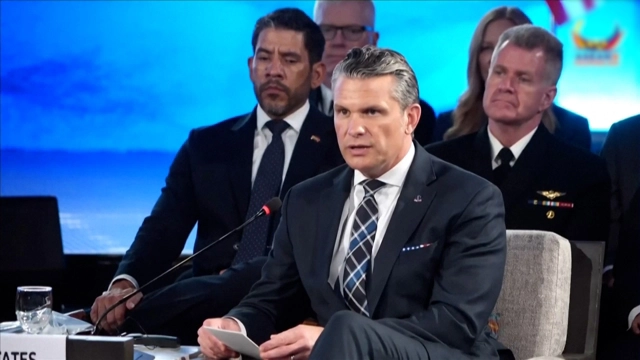
US Defense Secretary Pete Hegseth greets officials from across Southeast Asia at this meeting in Cebu in the Philippines...held on the sidelines of a summit of defense ministers from the ASEAN regional bloc.
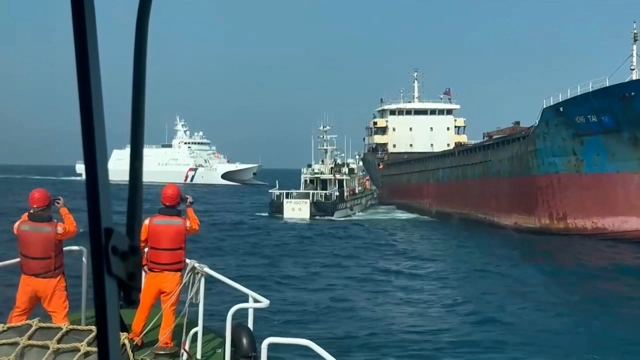
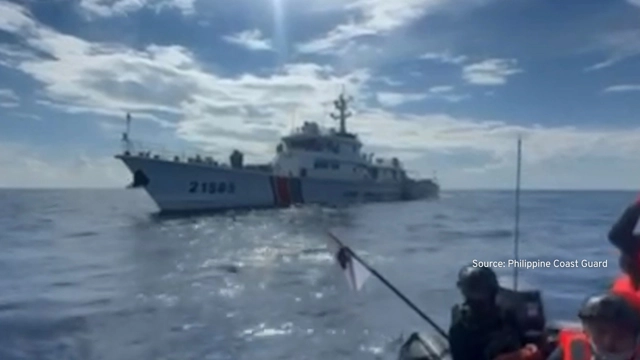
Beijing has been busy pushing its claims in this part of the world. Nearby, in the disputed South China Sea, Chinese vessels regularly clash with those of US ally the Philippines. Manila says Beijing has nearly doubled its military and coast guard presence in September alone.
Meanwhile, the US military says it’s prepared in the Indo-Pacific, acting under the assumption that China will have the capability to take Taiwan by force next year...and that it might try do to so.
These two threats put the so-called First Island Chain -- a string of islands that separates China from the open Pacific—under pressure. And with this pressure in the background, Hegseth wants ASEAN nations to join the US in forming a new defense framework.
PETE HEGSETH, US DEFENSE SECRETARY:
"The approach we're taking we describe, we describe as strong, quiet and clear. Strong enough to deter coercion and aggression, quiet enough to avoid needless escalation or public theatrics, and to let our actions speak for themselves. But clear enough that our friends, our partners and potential adversaries understand precisely where the United States stands and that we will defend our interests and the interests of our allies and partners. That is, by definition, peace through strength."
The United States is not the only power watching China with concern. Japan, another link in the First Island Chain, has sent its defense minister Koizumi Shinjiro to the Philippines. In a separate meeting in Cebu, Koizumi and Hegseth discussed the need for what they call “denial defense” -- an effective deterrent to China along the chain.
But Japan isn’t just counting on the US for support. In Tokyo Wednesday, Prime Minister Takaichi Sanae hosted German Chancellor Friedrich Merz. Reducing so-called one-sided dependencies was one theme of this meeting. And Merz said Germany is ready to play its own role in upholding peace—sending, for example, over 100 soldiers this month to the Keen Sword exercise, focused not far from Taiwan.
FRIEDRICH MERZ, GERMAN CHANCELLOR:
"Secondly, In the Indo-Pacific, we look with concern at rising tensions. This applies in particular to the Taiwan Strait. Here too, the prohibition on the use of force enshrined in the Charter of the United Nations applies. It is of the utmost importance that all parties act with the greatest prudence. Germany will maintain its One China policy, but how we implement that policy is for us to decide."
TAKAICHI SANAE, JAPANESE PRIME MINISTER:
"We also reaffirmed our strong cooperation on regional and international challenges, including the situation in the Indo-Pacific and the situation in Ukraine. We will continue to deepen our discussions at the dinner later this evening. As irreplaceable premium partners, our two countries will grow together and make meaningful contributions to addressing the various challenges faced by the international community."
As regional tensions mount, so too, does regional cooperation as partners see a critical few years ahead in Indo-Pacific security.
Hank Hsu and John Van Trieste for TaiwanPlus.
 03:15
 02:07
 02:40
 03:25
 01:59
 00:54
 02:26
 02:43
 00:37
 00:48
 03:06
 04:09
 00:32
 03:29
 00:54
 03:28