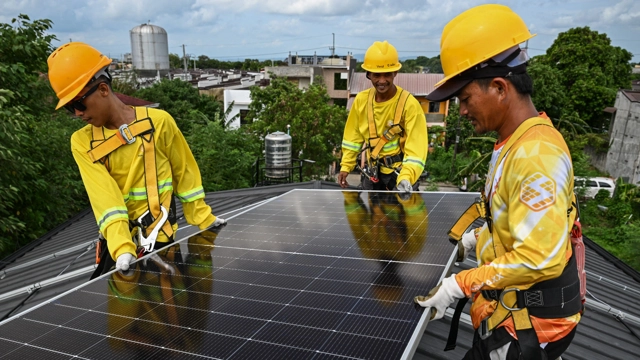
It’s not an easy task... hoisting large, heavy solar panels and installing them on a rooftop. And for these contractors in the Philippines, their work has no signs of slowing down. Business is booming.
BRIAN LITAN, SOLAR CONTRACTOR:
"Before, in a month we usually catered to only two clients, maximum three, but now in one month we finish almost fourteen to thirteen projects a month. So the demand is very high."
The Philippines is seeing a solar power boom. A recent report estimates that rooftop installations have doubled in the country since 2025. The main supplier of solar power equipment, China, sent over nearly $14 billion US dollars’ worth of goods in the first half of this year – that’s up more than a quarter from last year.
For Edwin Salas, a bus driver outside of Manila, buying 20 panels for his own home was a no-brainer.
EDWIN SALAS, SOLAR CUSTOMER:
"We decided to switch to solar because electricity bills are getting more expensive and there have been frequent power cuts recently. These are the reasons why we decided to invest in solar panels. Even if we don't achieve a zero bill, we'll still save a lot."
He’s not alone. Many are considering switching to solar power because skyrocketing electric costs are just too much for the average person to bear.
ADRIAN SABATERA, SOFTWARE ENGINEER:
"That's already a hefty sum of your paycheck. On a monthly basis, it will already eat into your salary significantly — for some, that's 30% of their income, for others, it's their entire payroll. People will actually start to think about this, and I wouldn't be shocked if a third of the middle class population tries to find their way to this setup."
The Philippine government hopes this is the case. They have set a target of having renewables make up 35 percent of the national energy mix by 2030. But industry insiders say this solar push is actually being driven from the bottom up by members of the public.
LEXUS GREPO, OWNER SOLARMAXX:
"Nowadays, many people are working from home, like the virtual assistants, all of those people will be needing electricity 24/7, they need a reliable source of power."
And there’s room to grow. Recent estimates say of all available rooftops in the country only half a percent are solar-equipped.
But a big barrier for most Filipinos in switching to solar is the upfront costs. A typical household system runs anywhere from $3 to 5000 US dollars to install. Meanwhile, there are few subsidy options and getting the required approvals can take months in some areas.
Still, some providers point to recent instability in the global oil market as a driver for many customers.
DREXLER PANTI, GENERAL MANAGER SESCO CORP:
"since the war [in the Middle East] started, our clients are now looking for more security than savings. Because as you can see, other countries are very dependent on oil, some have experienced nationwide blackouts. So our clients are preparing for that kind of scenario here in the Philippines."
And it’s not just residents, commercial spaces are getting in the solar game too.
For this company’s shopping centers, about 50 percent of their energy now comes from solar.
FREDERIC DYBUNCIO, PRESIDENT AND CEO SM INVESTMENTS CORP.:
"Solar panels continue to go down in price, right? So that's something which the Philippines will actually be able to take advantage of."
Some hope the Philippines is on track to be the next Australia, where one in three houses now have solar panels. And if power costs keep their current trajectory, then many Filipinos may have fewer choices left.
Hank Hsu and Michael Reid for TaiwanPlus.
 03:25
 01:59
 00:54
 02:26
 02:43
 00:37
 00:48
 03:06
 04:09
 00:32
 03:29
 00:54
 03:28
 02:51
 02:34
 00:26