Workers prepare bright green seagrass shoots on Kariyachalli, a small, uninhabited island off India’s east coast. The shoots will be planted on the ocean floor, where they will hopefully grow into underwater meadows.
Their job is pressing, as scientists warn the entire island could disappear in a decade.
Nearby, artificial reef modules weighing several tons are lowered into the sea. They’re designed to block waves and protect transplanted corals.
K. DIRAVIYA RA, SUGANTHI DEVADASON MARINE RESEARCH INSTITUTE:
"If we keep restoring and keep the coral biomass intact they will eventually adapt to the changing climatic conditions and will form the future reef."
The work is part of a nearly five million US dollar state project to keep the small island above water. Rising seas have already put more than 80 percent of Kariyachalli’s landmass beneath the waves.
SUPRIYA SAHU, SENIOR OFFICIAL TAMIL NADU STATE:
"The idea is to kind of create a model where the focus is laid on a community led conservation effort for both conservation of biodiversity, as well as for climate resilience."
The project also provides some extra income for local workers during their off season from nearby salt fields.
DEVKANI, SEAGRASS RESTORATION WORKER:
"During the three months when there is no work in the salt pans, we had to borrow loans at high interest rate to make ends meet. But this year because of this sea-based work, we didn't have to."
Fishing communities in the area also hope to see better catches.
MARTINA, SEAGRASS RESTORATION WORKER:
"Growing seagrass increases the reproduction of fish and saves the ecosystem, which is useful to us and improves our livelihood."
Beyond providing jobs, the project combats long-term climate threats. Kariyachalli is one of about 20 islands along the coast. And scientists warn that losing the island will take away one of the area’s best natural defenses.
K. DIRAVIYA RAJ, SUGANTHI DEVADASON MARINE RESEARCH INSTITUTE:
"These islands are very, very important to protect the mainland. If you see the impact of tsunami back in 2004 the impact is very minimal between Tuticorin and Rameswaram. In fact, there is no impact at all. This is because of these islands. These are like barriers that stop all the calamities there itself."
Project like these have proven effective elsewhere.
On one island, artificial reef modules helped reclaim some land from the sea.
On another, transplanted corals survived a bleaching event better than older colonies.
The project on Kariyachalli finished in September. Scientists will now start four years of monitoring to see whether previous successes can be repeated here and keep the tiny yet important island above water.
John Su, Ted Chen and Bryn Thomas for TaiwanPlus
 00:35
00:35 00:51
00:51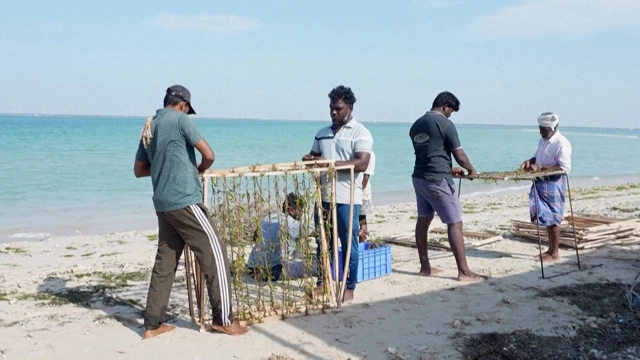 02:54
02:54 00:37
00:37 02:09
02:09 02:53
02:53 03:19
03:19 00:36
00:36 02:31
02:31 02:33
02:33 00:55
00:55 00:37
00:37 00:29
00:29 00:29
00:29 00:31
00:31 02:49
02:49