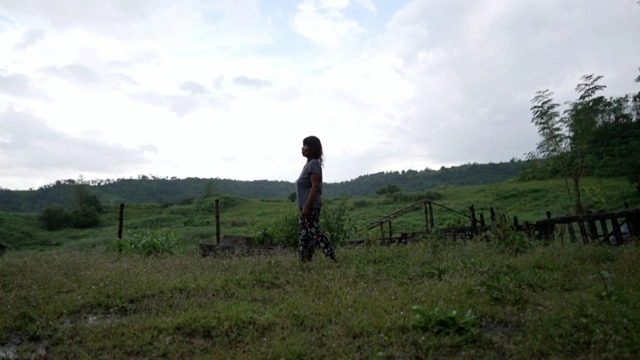
These grasslands may look pristine... but they’re at the center of a global race to secure the materials and manufacturing needed for artificial intelligence.
Petronila Munoz leads the Aetas Hungey Indigenous minority in Tarlac Province. She says one thousand of her people have already been asked to leave the area to make way for a major new manufacturing hub.
PETRONILA MUNOZ, CHIEF, AETA HUNGEY TRIBE:
"The reason why we're being firm about not leaving our ancestral land is our descendants. What will happen to them?"
In April, the US announced the Philippines had joined the Pax Silica initiative... to strengthen supply chain resilience for semiconductors and rare earths.
The Philippines has put aside more than 1,600 hectares of land in New Clark City for production of high-end components to be used in AI data centers.
But Munoz says her people have been told to move about 16 kilometers from their homes... with a land purchase offer of about 50 US cents per square meter.
She says their livelihoods and culture are tied to their ancestral land... which money cannot buy.
Her concerns are being echoed a hundred kilometers south, in Manila.
RENATO REYES, ACTIVIST:
"We are protesting the Pax Silica initiative and the economic corridor that will take away land from Filipino farmers and Indigenous people, take away mineral and water resources from the people."
But for a country with more than 3 million unemployed people, the initiative promises about 190,000 new jobs.... as well as an estimated 70 billion US dollars in investment from US companies.
Businesses in Taiwan, Singapore and South Korea are also in talks to cooperate around New Clark City.
CALIXTO CHIKIAMCO, POLITICAL ECONOMIST:
"We have to open up to foreign investments so that technology transfer will happen. AT the same time, our government has to be forced to make sure that we also develop the local talent and establish institutions that will facilitate the technology transfer."
But even the project's supporters say that the government's handling of the plans has been less than ideal.
CALIXTO CHIKIAMCO, POLITICAL ECONOMIST:
"It’s doing a terrible job of communicating to the general public what Pax Silica is about, what are the benefits, how we can protect local communities from any negative impact, how they will solve the water and energy problem. They have not been very forthcoming."
And even with no timeline confirmed, and many unanswered questions, the Aeta people have been told to move by December.
PETRONILA MUNOZ, CHIEF, AETA HUNGEY TRIBE:
"Our dream is for us to be free in our own land. That's what we dream of. But -- what will happen to us? That's our biggest question. But we will not leave. We don't want that Pax Silica."
As politicians dream of a future linked to the AI value chain, people like Munoz just hope to keep their ties to the land.
Joseph WU, Shir Bashi and Bryn Thomas for TaiwanPlus.
 02:58
02:58 02:34
02:34 03:37
03:37 02:31
02:31 02:04
02:04 00:28
00:28 01:51
01:51 01:54
01:54 02:45
02:45 02:20
02:20 05:35
05:35 00:41
00:41 00:23
00:23 02:37
02:37 00:21
00:21 00:36
00:36