Okinawa's Coral Reefs Under Threat From Climate Change
Scientists are searching for a way to save Okinawa's coral reefs before another mass bleaching happens. One coral farmer is growing resilient coral by exposing them to strong UV early on. Another team of researchers is studying what happens to a marine environment without coral, which are home to thousands of fish species.
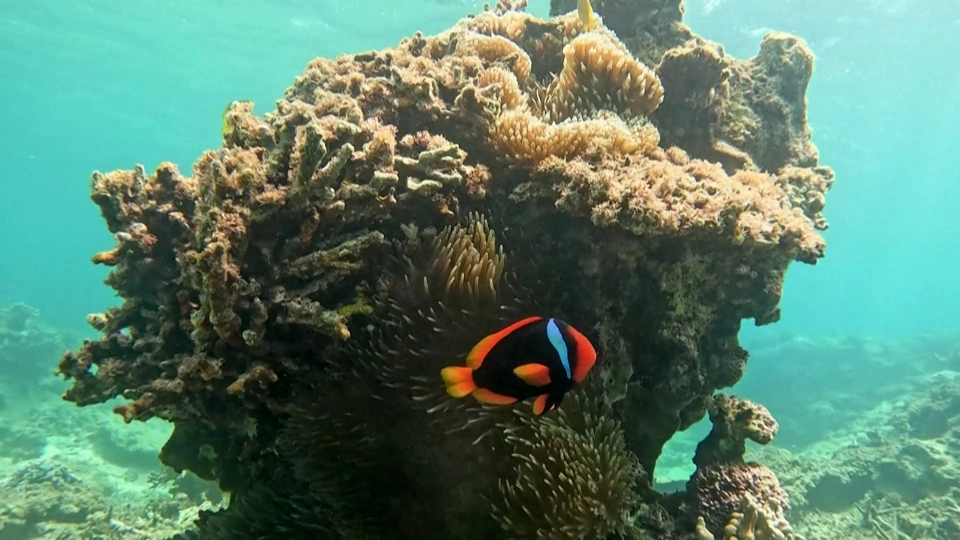
In the clear blue waters around Japan's southern islands of Okinawa, coral reefs are dying.
The ocean is experiencing a major heatwave... and with a strong El Niño coming, plus other threatening conditions, researchers at the Okinawa Institute of Science and Technology say the coral reefs may not be able to survive for much longer.
TIMOTHY RAVASI, PROFESSOR, OKINAWA INSTITUTE OF SCIENCE AND TECHNOLOGY (Onna, Japan)
The urgency is because if we don't understand what climate change or ocean warming, acidification does to coral reef ecosystems there is a chance we are going to lose them or change them forever.
It's been one of the hottest summers ever in Japan, with a new word, kokushobi, created to describe the heat – cruelly hot days.
And scientists are warning that a mass bleaching event may be inevitable... That's when corals turn white after losing the healthy algae that they rely on for nutrients. It's often caused by heat, UV stress or pollution.
TIMOTHY RAVASI, PROFESSOR, OKINAWA INSTITUTE OF SCIENCE AND TECHNOLOGY (Onna, Japan)
Maybe not this year, but next year it's just like a bomb ready to explode. So the likelihood will be, for me, if the situation is like that, it's almost 100% that soon in Okinawa or around the world we will have another mass bleaching event.
Mass bleaching doesn't kill coral directly, but it leaves them vulnerable to disease that could kill them.
And bleaching is devastating for the thousands of fish species that make coral reefs their home. In Ravasi's lab, scientists are testing how marine life adapts to heat... to better predict what could happen in an ocean without coral reefs.
In another part of Okinawa, coral farmer Kinjo Koji is trying another approach... trying to make coral stronger... by exposing them early on to strong UV rays. He says this technique helped his coral survive a 2024 bleaching.
But, there are critics.
KINJO KOJI, CORAL FARMER (Yomitan, Japan)
When we carry out this kind of work, people often tell us that we should "restore the sea to how it used to be." But the sea will never return to the way it was in the past. Our approach is therefore to create a place with a rich ecosystem that can adapt to the conditions of the coming era.
But making corals more resilient to climate change is just one part of the equation.
Tourism drives 80 percent of Okinawa's economy, but hotel construction and pollution also pose a threat to the coral reefs that so many come to see.
However, local conservationists say tourists can also be part of the solution.
IKENO SHOICHI, DIVING COMPANY OWNER (Onna, Japan)
We encourage tourists to take part in eco-friendly programs that aim to increase or protect corals. This way, tourists can develop a greater awareness of environmental protection, and local residents may also feel grateful to see more tourists taking part in such activities. I think this can create a mutually beneficial effect.
These local conservationists hope that their work will be enough to help save the coral reefs around their shores... before it's too late.