Fossil Fuel Investment Ban Pushed by Environment Minister
==
REPORTER:
The environment minister says the government wants to halt new fossil fuel investments, after a report found public funds were invested in the industry.
Peng Chi-ming (ENVIRONMENT MINISTER):
This involves many government agencies.
For example, the labor pension fund involves the labor ministry
and others involve the finance and economy ministries.
There are many stakeholders involved.
A consensus we share now is that
institutions will stop investing in fossil fuels.
But if they pull investments out now
it will greatly affect local industries.
Germany-based environmental NGO Urgewald says public records show Taiwan’s labor pension fund and its postal service have over 1.7 billion US dollars invested in fossil fuel firms. A total of 22 Taiwanese financial institutions are on the list. The report says firms they've invested in are actively expanding energy production from coal, oil and gas.
[==SOT]##
---
International Report Reveals Taiwan’s Public Investment in Fossil Fuels
==
REPORTER:
An international report finds Taiwan has public funds invested in companies relying on fossil fuels.
Hannah O'Neill (URGEWALD):
If you invest in this company, we interpret as you putting a bet basically on the business model of this company. And if this company is building out new fossil fuel assets, then you are kind of betting on this business model to work out.
Germany-based environmental NGO Urgewald says public records show Taiwan’s labor pension fund and its postal service have over 1.7 billion US dollars invested in fossil fuel firms. A total of 22 Taiwanese financial institutions are on the list. The report says firms they've invested in are actively expanding energy production from coal, oil and gas.
[==SOT]##
Taiwan’s Fossil Fuel Investments Disclosed
REPORTER:
To learn more about the implications of Taiwan's fossil fuel investments, reporter Irene Lin sat down with Urgewald's global partner in Taiwan, Chen Ting-yu at the Environmental Justice Foundation.
---
Key Interview: Chen Ting-yu (ENVIRONMENTAL JUSTICE FOUNDATION):
Two of them belong to our four major funds.
One is the labor pension fund and insurance fund managed by our Bureau of Labor Funds and the other is the postal savings of Chunghwa Post.
Of course, the funds operate with the intent of generating higher returns through investment to secure people’s retirement.
But securing retirement shouldn't just focus on the financial side but also on the environmental and social aspects.
REPORTER:
The two institutions you mentioned have a total share and bond holdings of 1.7 billion US dollars. How much weight does that kind of money carry when you compare it with Taiwan's decarbonization budget?
Chen Ting-yu (ENVIRONMENTAL JUSTICE FOUNDATION):
We all know that the environment ministry is responsible for driving environmental policies such as carbon fees, where emissions cost money.
Even for such institutions, the total annual budget is only [US$220 million to US$250 million].
Comparing the two our four major funds’ investments in fossil fuels are already six, seven or eight times that amount.
We think if the major funds can invest all of this money into projects that are truly environmentally friendly and gradually move away from fossil fuels it could actually have a massive impact on Taiwan’s overall policy direction.
REPORTER:
Taiwan only just collected its first carbon fee payment this May. What does this report say about Taiwan's 2050 net-zero target?
Chen Ting-yu (ENVIRONMENTAL JUSTICE FOUNDATION):
Even after we’ve collected carbon fees at the same time our funds still seem to be funneling money to subsidize the fossil fuel industries that are making climate change even more severe and acute.
Everyone talks about how crucial financial support is [for green transition] yet the role of our four major funds is the only thing that has been consistently missing.
We believe they play a vital role. They even represent our national carbon reduction efforts.
No matter the impact on the funds’ returns or the impact our rising temperatures may have on future generations we hope the government will investigate and assess all of this and ultimately disclose it fully to the public.
REPORTER:
That was Chen Ting-yu, climate campaigner at the Environmental Justice Foundation.
 00:59
00:59 01:23
01:23 01:30
01:30 00:45
00:45 02:28
02:28 01:39
01:39 02:51
02:51 03:07
03:07 01:38
01:38 01:36
01:36 04:22
04:22 01:44
01:44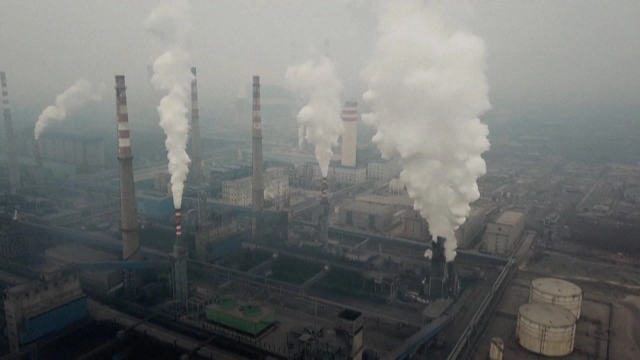 03:33
03:33 01:32
01:32 01:05
01:05 01:49
01:49