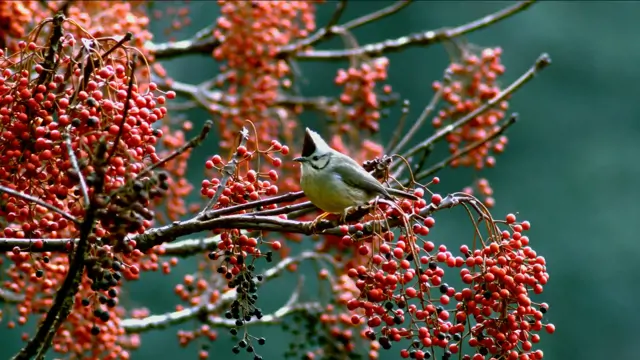
"Formosa Forevermore" is a documentary series that uses the beauty of wild birds and starry skies, paired with unique traditional songs, to engage international audiences. It tells stories that belong to Taiwan, guiding viewers from home and abroad to experience Taiwan’s ecology and environment.
For the Japanese white-eye, whose size is around 10 centimeters, the fruit of this large-leaved banyan is really a little too big. So it uses its sharp, thin beak to peck away at the fruit.
This type of tree produces abundant fruit, which always attracts a hoard of various birds, including many migratory birds that fly south from the north, as well as different resident birds local to Taiwan. Together, they indulge in the feast.
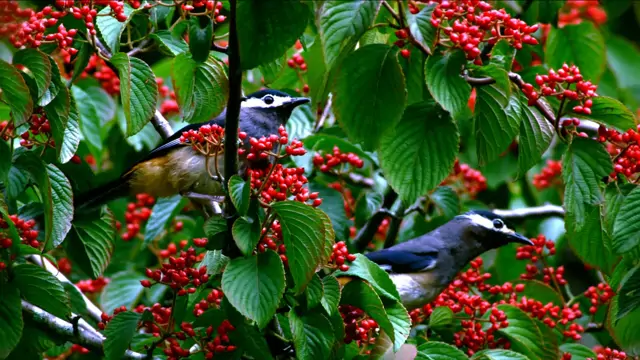
With its main winter home located in North China and Japan, and a particular love for berries, the Japanese Waxwing eats to replenish lost energy during its long-distance migration.
Of course, this fruit is even more popular with Taiwan’s local birds, for example, one of the most common birds in Taiwan — the light-vented bulbul, would never miss the event. Large-leaved banyans are extremely common in Taiwan’s plains and low-altitude mountains.
As their flowers are all hidden in their fruit, from the outside, it appears as though they do not flower and grow fruit directly, therefore their fruit is called the “non- flowering fruit” in Chinese. During fruiting season, not only do they attract birds, even mammals covet them, forming fig buffets for the local wildlife.
However, the fruit’s largest size reaches 1.5 centimeters, which seems a little large for the Japanese waxwing?