It's playtime for a special team at a company called Dognosis in Bengaluru, India. But these dogs are training for a serious job: using their extraordinary sense of smell to sniff out disease.
Company co-founder Akash Kulgod says the science behind the idea isn’t new.
AKASH KULGOD, DOGNOSIS CO-FOUNDER:
"There have been about 50 peer-reviewed papers on how dogs can sniff out cancers, Covid-19, other kinds of disorders like Parkinson's."
Dognosis hopes to commercialize that innate ability into a practical screening tool for up to seven types of cancer.
Customers breathe into a cotton mask for about 10 minutes before the mask is sealed and sent to the lab.
AKASH KULGOD, DOGNOSIS CO-FOUNDER:
"We basically built sensors that sit on the dogs. It's a helmet and a harness that is fully non-invasive. It's like a doggy Ironman suit which measures their brain activity, their respiratory patterns, their body language. And then we have machine-learning models, which can take the data and predict whether the dog is smelling a certain odor, like cancer."
Company co-founder Itamar Bitan, who spent four years in an Israeli special-forces canine unit, explains how it works.
ITAMAR BITAN, DOGNOSIS CO-FOUNDER:
"The dog steps on the platform and it just presents, you know, a line-up of samples. And out of curiosity, the dogs engages and smells the samples, on some samples nothing happens, on the other samples, they hear this sound and food comes out. And basically a positive reinforcement, a very simple classic conditioning."
Bitan added that a dog can do thousands of sniffs in an hour.
That can be an effective preventative measure for India, where one in nine of its 1.4 billion population are likely to develop cancer.
ITAMAR BITAN, DOGNOSIS CO-FOUNDER:
"So you'll see some of the dogs are under the feeder expecting rewards, some dogs freeze, some dogs scratch the sample with excitement, and we don't really care, as long as the machine that learns how the dogs react to the sample is very consistent and you know is very accurate."
Oncologists are watching the project with cautious interest.
According to AFP, one Bengaluru cancer specialist calls it a promising early signal — but says it needs more testing.
Another says it's too early to tell how useful it'll be for patients.
Dognosis hopes to launch commercially next year, right behind competitors already in Germany and Israel, chasing the same scent.
The company says it's not just about diagnosis, but also about human-canine communication, as it works to perfect the science.
Alex Chen, Ted Chen and Bryn Thomas for TaiwanPlus.
 05:35
05:35 00:41
00:41 00:23
00:23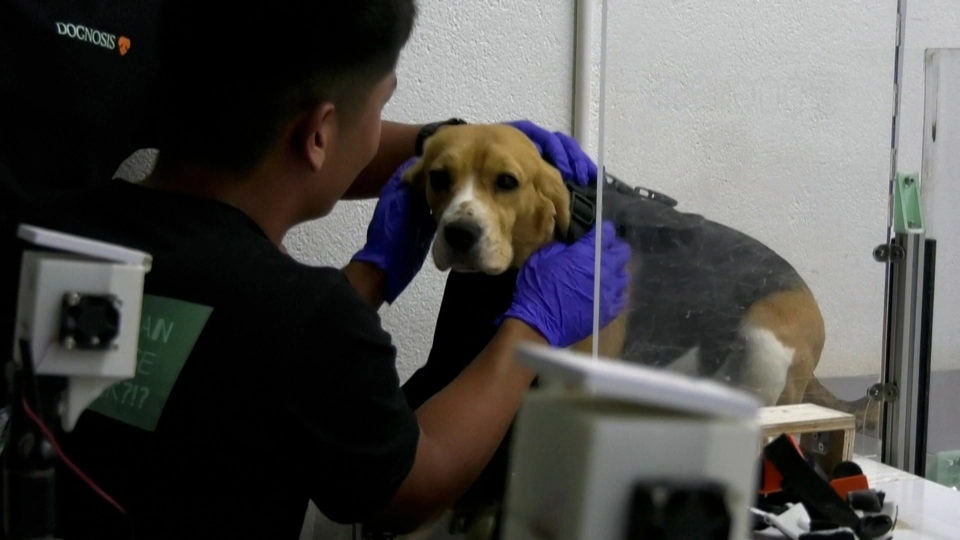 02:37
02:37 00:21
00:21 00:36
00:36 03:49
03:49 00:39
00:39 01:02
01:02 02:28
02:28 02:46
02:46 03:14
03:14 02:24
02:24 00:33
00:33 03:22
03:22 02:37
02:37