Okinawan Artists Challenge Japan's Ban on Cosmetic Tattoos
By Alex Chen/Ted Chen/Yvonne Yang
Japan's Cosmetic Tattoo Ban Challenged
FIGHT TO LEGALIZE COSMETIC TATTOOS
Okinawan artists challenge Japan's ink rules and taboos
REPORTER:
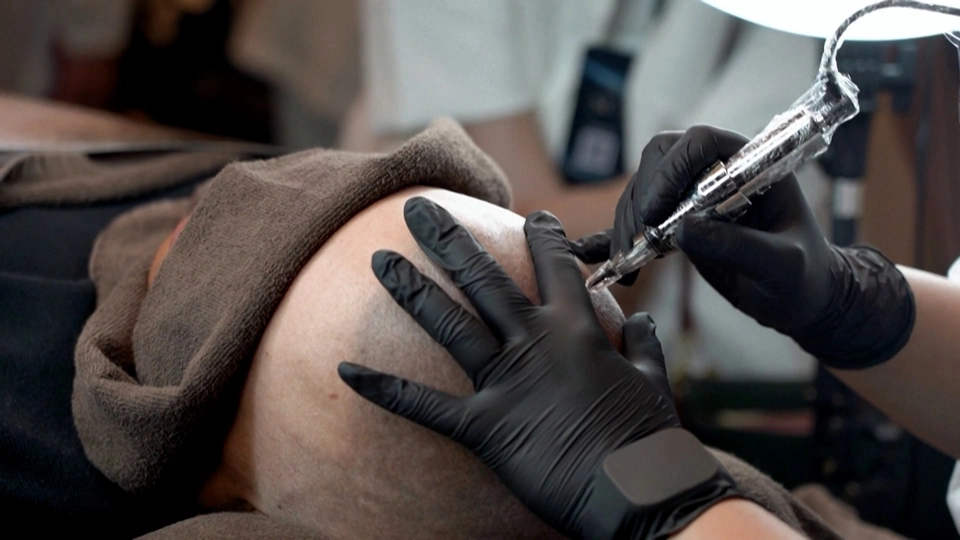
Tattooists are demonstrating scalp micropigmentation, or SMP, at a convention center in Okinawa. It’s in open defiance of Japanese law, risking legal consequences. Tattoo artist Remy Browman, who founded the Japan Tattoo Hygiene Association, says his industry already takes safety seriously.
Remy Browman (TATTOO ARTIST):
What we are doing now doesn't hurt, we don't need anesthesia. And we teach how to prevent the spread of diseases such as HIV and hepatitis.
REPORTER:
But he says the law hasn’t caught up.
Remy Browman (TATTOO ARTIST):
Even for something as simple as cutting hair, there are rules in place. But when it comes to tattoos, there are no rules at all. That’s strange, right?
REPORTER:
Outlawed during the Meiji Restoration as Japan modernized, tattooing was only legalized under the postwar US occupation, but then left largely unregulated.
REPORTER:
It was not until 2020 that Japan’s Supreme Court took action. It ruled that decorative tattooing does not have to be performed by doctors. But the same did not apply to SMP and permanent make-up, leaving artists stranded in a legal gray area.
Shinmasu Michiko (HAIRSTYLIST):
It's only Japan, right? All over the world, permanent make-up is applied by beauty professionals. I wonder why Japan is the exception. It makes customers feel as though they’re doing something wrong.
REPORTER:
Japan’s tattoo stigma runs deep. Lingering ties to criminals and outcasts are hard to shake. People are still not allowed to show ink in many public places. Attitudes are changing, but slowly.
Sameshima Yasuaki (SMP BUSINESS OPERATOR):
Nowadays, a lot of people have tattoos simply as something fashionable. But in the past, there were also tattoos of a different kind, and today's tattoos are still viewed in the same way. That's why that negative image is so difficult to get rid of.
REPORTER:
A Japanese health official says that SMP has an established history of doctors' involvement. As recently as December, the health ministry warned that unlicensed practitioners could face criminal complaints and even arrest.
Miyahira Tatsuki (TATTOO ARTIST):
I think Japan is quite strict, really. Especially for me, being from Okinawa, I’ve been exposed to it since I was little, so I think attitudes could be a little more open.
REPORTER:
So the fight is on in Okinawa, once its own kingdom, and no stranger to pushing back against rules set by Tokyo.