Remembering September 11: A Generation’s Burden and Honor
REPORTER:
For Michael Touhey, each September 11 is a day of tough and unanswerable questions. On the morning of September 11, 2001, now nearly 25 years ago, he went into work like always at an airport check-in counter in Portland, Maine.
REPORTER:
Two passengers that morning gave him an odd feeling. But he fought that feeling and gave them their boarding passes.
REPORTER:
Those passengers turned out to be hijackers who boarded and seized the flight that ultimately crashed into the North Tower of New York’s World Trade Center.
Michael Touhey (RETIRED US AIRWAYS TICKET AGENT):
And in a sense, they would have said, 'well, you're just profiling these people and that's illegal.' So, you know, I don't want to get in a pissing contest about that. You know, my opinion is that I didn't listen to my gut. And it turned out to be an awful thing. But it wasn't that I was right. It's just that it could have changed something. Not that it would have, but it could have. Who knows?
REPORTER:
It took months of therapy to recover from visions of one of the hijackers’ faces.
REPORTER:
These days, he’s reached a stage of acceptance. But he still keeps the local newspaper reports of the attacks in his home. Their headlines will never go away.
REPORTER:
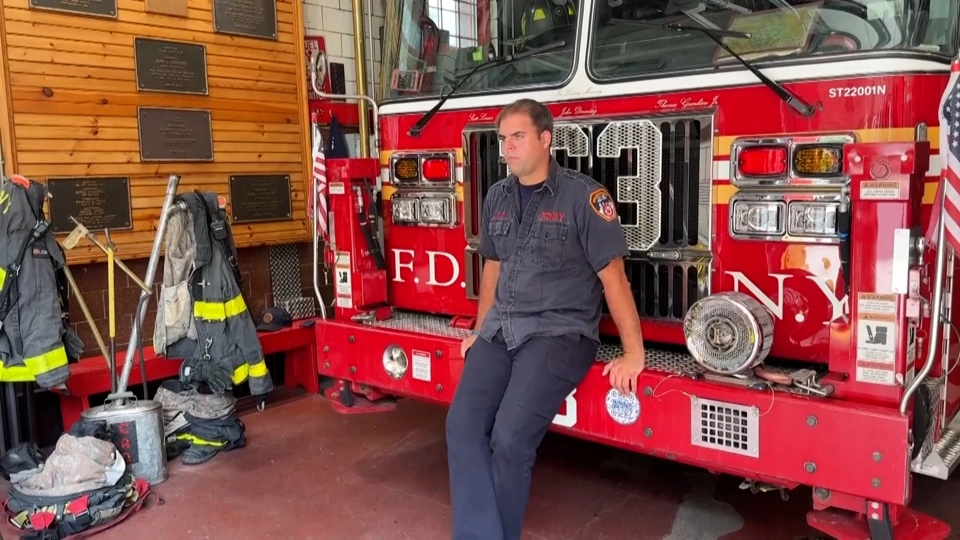
For New York firefighter Scott Larsen, September 11, 2001 is rather hazy—he was only four at the time. But his father, also a firefighter, died that day, climbing up the burning World Trade Center never to come back.
REPORTER:
Today, Scott works at the same firehouse his father did. There are reminders everywhere, including a plaque dedicated to his father and a firetruck inscribed with his name. He often wonders at what his dad did that day, fighting a doomed battle against the flames, with a recording in the 9/11 museum preserving some of his last words.
Scott B. Larsen (NEW YORK FIREFIGHTER):
If you go to the museum in Manhattan his voice is actually, you can actually hear his on his walkie-talkie, handy talkie, you can hear him actually speaking at the museum. It's kind of trippy.
REPORTER:
Scott is one of 58 children of firefighters killed in the attacks on New York who have grown up to become firefighters themselves. And even some with no memory of the day at all are planning to join – like Scott’s younger brother born two days after the attacks.
REPORTER:
But the world has changed much in a quarter of a century. For younger generations of Americans, September 11 is a historical event. New rounds of turmoil have shaped their consciousness more, as historian Jonathan David Hepworth explains.
Jonathan David Hepworth (CLEMSON UNIVERSITY):
We've had at least two major wars the United States has been involved in and we've had the Great Recession, we've had the COVID-19 pandemic. There's been a lot of things that have been very jolting experiences for a lot of people. As later generations come, those later experiences are probably going to be more formative to them than September 11th.
REPORTER:
And as time passes, victims’ loved ones heal as they endeavor to keep memories alive.
Logan Miller (9/11 MEMORIAL & MUSEUM VISIONARY NETWORK):
I think it's a burden that falls upon my generation to make sure that their legacy is remembered, as the generation before us, I think, are starting to get a bit older or are no longer with us. And so, although it's a burden, I think it's also an honor.
REPORTER:
25 years on, the crowds of visitors at the 9/11 memorial in New York and the tributes they leave suggest this somber work is helping to keep the memory of that day, and its victims and heroes, alive in the hearts of generations old and new.
 03:49
03:49 00:34
00:34 00:36
00:36 00:33
00:33 00:24
00:24 02:11
02:11 03:23
03:23 00:42
00:42 00:48
00:48 00:40
00:40 02:56
02:56 03:24
03:24 00:30
00:30 02:36
02:36 00:23
00:23 00:33
00:33