Magnitude-7.4 Earthquake in Colombia Leaves at Least 130 Dead
By Alex Chen/John Van Trieste
At least 130 people have been killed after a magnitude-7.4 earthquake struck Colombia, with the death toll likely to rise with an unknown number of people trapped beneath collapsed buildings. President Abelardo de la Espriella, who was sworn in just days ago, has declared a state of emergency.
Colombia Earthquake: Rescue Efforts and Rising Concerns
REPORTER:
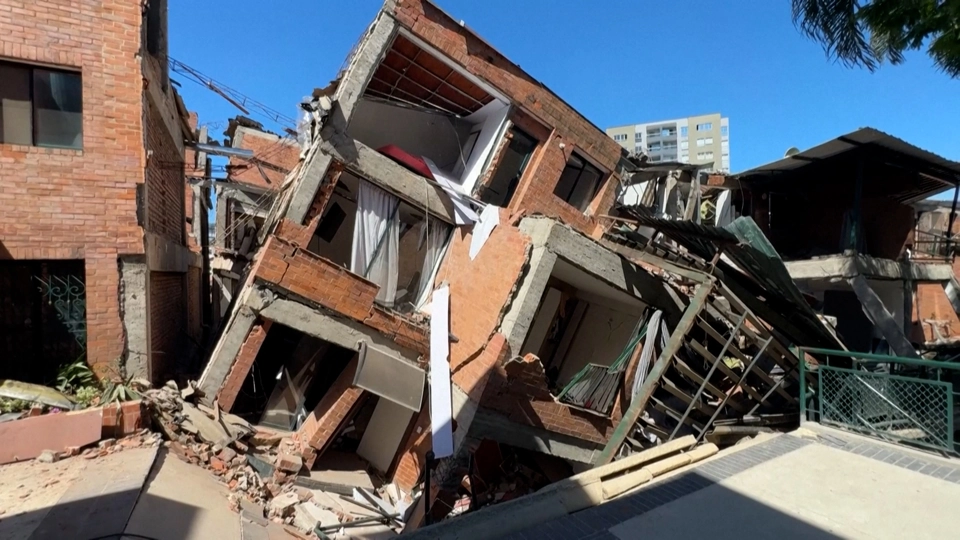
A cheer rises around the ruins of a building in the Colombian city of Cali. Firefighters have found someone alive.
REPORTER:
Colombia's streets are littered with rubble after a magnitude 7.4 earthquake struck early in the morning. Across the country, an unknown number of people are trapped beneath flattened buildings. For their relatives, it’s an anguished wait.
Andres Burbano (RESIDENT):
My apartment was 302, and it was completely destroyed. My wife was inside. Thankfully, my daughter had left early, and so had I. I left early for work. And look, this is what happened. We haven't been able to rescue her. We don't know whether she is alive or dead.
REPORTER:
Colombia is no stranger to disastrous earthquakes: another, centered in the same area, killed 1,200 people in 1999.
Saul Paz Martinez (EARTHQUAKE SURVIVOR):
I've always been pretty calm, but I thought, well let's wait for it to pass, but we saw that the magnitude was too strong. So we searched for a place where we knew was solid ground here in the square. I think that if it had lasted five more seconds, there wouldn't be anything left. I think we really reached the limit of resistance.
REPORTER:
The earthquake comes as an early test of leadership for President Abelardo de la Espriella, who was inaugurated just days ago. He’s declared a state of emergency.
Abelardo de la Espriella (COLOMBIAN PRESIDENT):
The first priority is rescuing the people who are under the rubble. That is the priority, rescuing the people who are still under the rubble.
REPORTER:
There’s also mounting concern among survivors over how they’ll make it through the coming days without access to basic utilities.
David Rivilla (EARTHQUAKE SURVIVOR):
There's no electricity, no water, no power and no internet either, and the city is practically at a standstill in terms of traffic, water and internet service—I repeat, water.
REPORTER:
Pledges of help are coming in from abroad—including from neighboring Venezuela, itself still recovering from twin earthquakes in June that killed thousands.
REPORTER:
But there’s a realization that getting help to where it’s needed may not be easy. The quake's epicenter is in a rural, lower-income region that’s more difficult to access. And aid groups are especially worried about some of the most vulnerable: children.
Bárbara Melo (COORDINATOR OF COMMUNICATIONS, WORLD VISION COLOMBIA):
Right now, we are trying to get some food, water and above all, we're trying to display people on the field so we can be there with the children and establish something that we call child-friendly spaces. These are spaces where children, if they lost their parents or they don't know where they are, can come together, have some space of activities to play. To become children again because these kinds of situations are very concerning for them.
REPORTER:
For now, Colombians are banding together and helping themselves, though, professionals and volunteers combing the destruction—and not giving up hope that there are lives still to save.
Alex Chen and John Van Trieste for TaiwanPlus.