REPORTER:
A top official from Taiwan’s main opposition party, the Kuomintang, has met with one of the top leaders of the Chinese Communist Party in Beijing.
It’s one of the highest-level meetings between the two sides in years. KMT Vice Chair Hsiao Hsu-tsen greeted Wang Huning, one of the CCP’s Politburo members, on a visit for a cross-strait forum.
Just as on the first day of the forum, Hsiao emphasized opposing Taiwanese independence and adhering to the 1992 Consensus: an understanding that both sides belong to “one China,” but each is allowed to have their own interpretation of which “China” that is.
Hsiao Hsu-tsen (KMT VICE CHAIR):
I sincerely hope that in the future both sides of the Taiwan Strait will prioritize the people’s prosperity, adhere to the “1992 Consensus,” oppose Taiwan independence, seek common ground and set aside disputes.
REPORTER:
Dozens of Taiwanese and Chinese scholars also attended the think tank exchange. And while the forum was supposed to focus on cross-strait exchanges, not politics, both sides touched on the 1992 Consensus, which is not recognized by Taiwan’s ruling Democratic Progressive Party.
Song Tao (DIRECTOR, TAIWAN AFFAIRS OFFICE):
The KMT and the CCP shoulder the unshirkable responsibility to promote the peaceful development of cross-strait relations and to safeguard the homeland of the Chinese nation. We unswervingly adhere to the “1992 Consensus,” oppose Taiwan independence and lead the development of cross-strait relations.
REPORTER:
In a statement on Tuesday, both sides agreed to promote open travel across the strait, link up major tech industries, cooperate on medical training, promote environmental protection and integrate disaster response.
But Taiwan’s Mainland Affairs Council condemned the exchange, saying that China is no friend to Taiwan.
Chiu Chui-cheng (MINISTER, MAINLAND AFFAIRS COUNCIL):
These conversations were neither friendly nor simple and sounded more like a lecture, not an exchange. The current cross-strait situation is quite dire primarily because of the pressure China has been putting on Taiwan in recent years.
REPORTER:
The KMT’s new chair has been seeking more exchanges with China, even calling for an invitation to meet with Chinese President Xi Jinping. Her calls come amid high tensions between the two sides, with her party hoping that more communication can cool things down. But with China’s aggression showing no signs of letting up, Taiwan’s government warns that any exchanges could come at a cost.
 03:34
03:34 00:31
00:31 00:35
00:35 00:42
00:42 02:54
02:54 00:52
00:52 02:33
02:33 04:03
04:03 03:00
03:00 01:12
01:12 02:27
02:27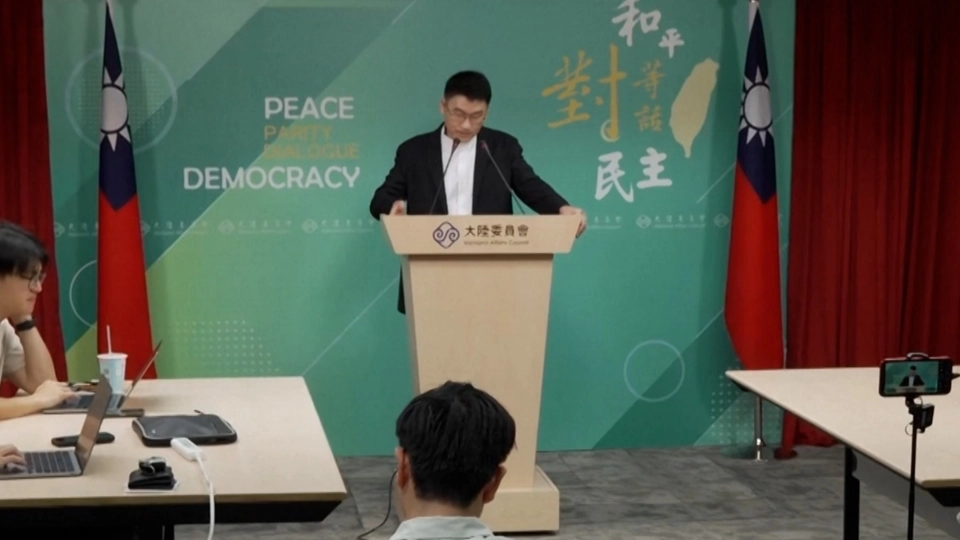 02:16
02:16 00:34
00:34 00:26
00:26 00:34
00:34 03:21
03:21