Undersea cables and pipelines, crucial to everyday life in Taiwan, have been repeatedly damaged in recent years.
There have been two cases this year of damage linked to China, with one of them becoming the first criminal case of its kind. Taiwan’s government is taking the next step to address what it calls China’s gray-zone tactics.
On Thursday, the Cabinet passed a series of amendments to seven existing infrastructure regulation laws, including communications, natural gas, water and weather monitoring.
They aim to protect the undersea cables and pipelines that connect these services to land and boost deterrence.
Our current Telecommunications Management Act already provides comprehensive protection for submarine telecommunications infrastructure.
This includes intentional acts
and aggravated forms of intent, attempted offenses
and even negligent conduct.
In short, all imaginable scenarios are covered.
The only missing element was a confiscation mechanism
which we are now introducing to complete the regulation.
Under the Telecommunications Management Act, perpetrators could be sentenced to up to seven years in prison and be fined over 330 thousand US dollars.
What the Cabinet now wants is to apply those same punishments to other violations, plus allow authorities to confiscate the ships or tools used to damage the cables.
All vessels sailing through the Taiwan Strait would be penalized if they refuse to identify themselves or if they operate in disguise.
The port authorities would also ban loitering vessels from docking.
As all know, the worst consequence of being denied port access
is that you cannot resupply.
You cannot repair or restock a vessel
without entering a port.
Without port access, you cannot berth in offshore waters.
That’s why this measure is an effective deterrent.
Taiwan’s communication cables are especially vulnerable to damage.
Of 24 existing cables, 10 are domestic – which have been the main target of sabotage in all confirmed cases - and 14 are international.
The number of damaged undersea cables connecting Taiwan’s main island to outlying islands reached a record 12 cases in 2023, and one expert warns of unreported cases.
The actual number here
is likely much higher.
That’s because when an undersea cable breaks
or even just needs maintenance
that information is often considered a business secret.
Specifically, it falls under the trade secrets
of the cable companies.
So the figures we see in the news
are far lower than the actual number of incidents
whether due to accidents or intentional sabotage.
One non-profit group says instead of punishment, more can be done to alert authorities at sea.
Authorities could designate certain waters
as high-sensitivity zones
to enhance monitoring protocols.
For example, when a vessel approaches the zone
authorities can issue a radio alert immediately.
This would activate defense mechanisms early.
For example, if the coast guard or naval patrols
are patrolling in nearby waters
they can warn the vessels preemptively.
The Cabinet’s draft will need the legislature’s approval before it can become law. But as tensions remain high in the Taiwan Strait, any more interference with these cables may lead to further escalation.
 04:02
04:02 00:31
00:31 02:54
02:54 02:33
02:33 04:03
04:03 03:00
03:00 00:26
00:26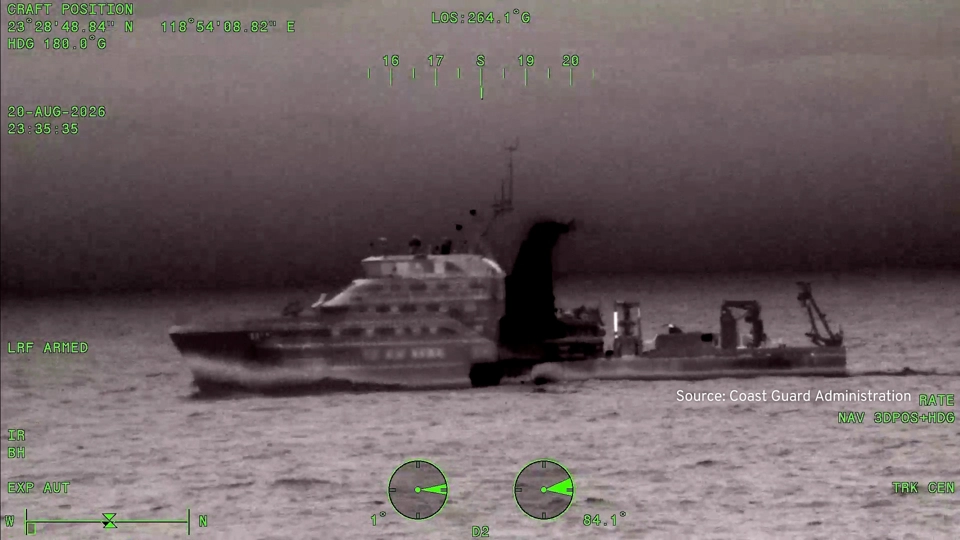 00:35
00:35 03:03
03:03 02:56
02:56 00:27
00:27 00:26
00:26 00:33
00:33 03:21
03:21 03:19
03:19 03:23
03:23