War Spreads Across Middle East Following Strike on Iran's Supreme Leader
Until Tuesday, this building housed the body charged with finding a replacement for Iran’s Supreme Leader Ali Khamenei, who was killed in a recent US-Israeli strike. Now, it too has been hit, leaving it a gutted ruin.
The US-based Human Rights Activists News Agency says since Saturday over 1,000 civilians have been killed across Iran, nearly 200 alone in this all-girl’s school in the south.
Iran’s Ambassador to the UN says planned talks with the US are off. This is war.
Ali Bahreini (IRANIAN UN AMBASSADOR):
Now, the only language for talking with the United States is the language of defense.
And Iran continues to strike back. Here in central Israel, patients and doctors crowd into an underground medical bunker as missile alerts sound.
Dr. Omer Nive (DEPUTY DIRECTOR, SCHNEIDER CHILDREN’S HOSPITAL):
They are really afraid, scary, the alarms are turning on every few minutes and it's a very, very challenging situation for our patients.
The war has spread beyond Iran and Israel to engulf the whole region, though. Iran’s also kept up attacks on US assets around the Middle East. Bystanders captured the panic as a drone slammed into the ground just outside the US consulate in Dubai.
It's hitting oil production in neighboring countries, with attacks like on this Emirati facility.
It's also keeping this global chokepoint for oil, the Strait of Hormuz to its south closed—threatening any ships that try to pass.
And Israel is now launching deadly attacks on neighboring Lebanon, home to Iranian proxy Hezbollah. At least four were killed in this strike in the eastern city of Baalbek.
Israel has also blasted this hotel in a Beirut suburb.
As the war spreads, the rationale for it is shifting—at least in Washington. Trump says Iran had plans to strike, and the US had to preempt them.
Donald Trump (US PRESIDENT):
We were having negotiations with these lunatics and it was my opinion that they were going to attack first. They were going to attack. If we didn't do it.
That’s not how US Secretary of State Marco Rubio explained the war a day earlier: he said Israel had planned the first strike, forcing the US to protect its troops in the Middle East from Iranian retaliation.
Some in the US Congress, especially Democrats, are concerned the war will be open-ended. The Senate is set to vote Wednesday—and the House Thursday—on blocking Trump from further attacks without Congress’ approval.
Despite the war, some Iranians who’ve had to leave have fragile hopes for the future of their homeland. Some who still have family in Iran are watching intently, hoping for big changes.
Afagh Farhadi (IRANIAN IN THE US):
My husband and I were talking today that maybe this Persian New Year, which is in March, we are maybe too optimistic, but we were thinking that maybe this whole war will be ended and maybe we can go in March to Iran and help with the revolution and be in Iran for the Persian New Year.
It’s a cautious hope some newly fled Iranians crossing the border into Turkey share.
After what we've been through all these years, we are hoping that maybe 2-3 months later, we can see extreme change in our country.
The US though, seems intent on fighting, with the Secretary of State threatening an escalation. Already, the US military says it’s hit almost 2,000 targets in Iran, nearly double the number of early strikes in the 2003 Iraq War. So as the war enters its fifth day, it’s impossible to tell whether hopes for a swift peace are at all realistic.
 02:15
02:15 03:07
03:07 03:23
03:23 03:25
03:25 03:23
03:23 02:42
02:42 02:54
02:54 02:56
02:56 03:24
03:24 02:33
02:33 00:27
00:27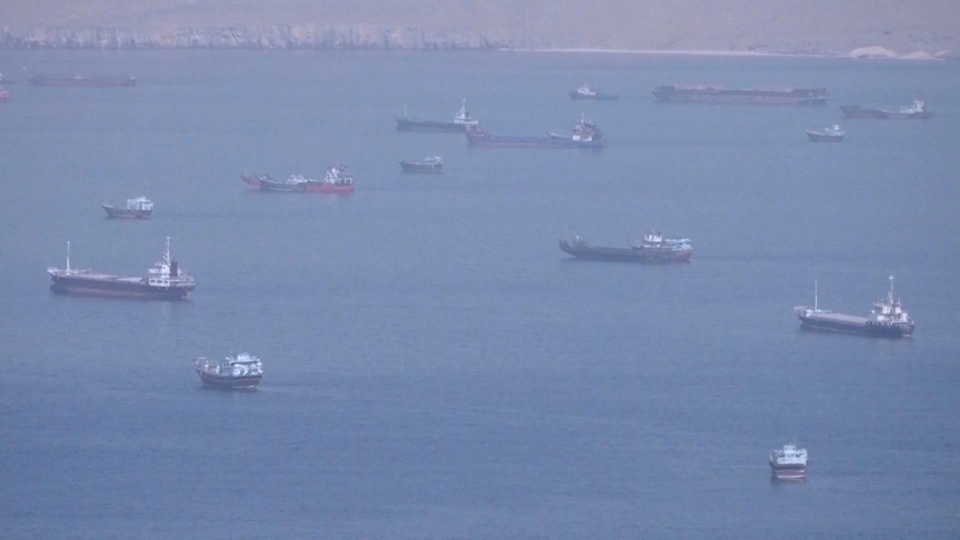 00:30
00:30 02:36
02:36 00:33
00:33 02:50
02:50 03:09
03:09