Shangri-La Dialogue 2026: Security Officials Voice Concerns Over China
REPORTER:
Top security officials from around the world were in Singapore this weekend at the annual Shangri-la Dialogue, held by the London-based International Institute for Strategic Studies.
The forum comes at a time of increasing global uncertainty, from the war in the Middle East to rising tensions to the Indo-Pacific.
REPORTER:
On Day 2, US defense secretary Pete Hegseth delivered a keynote speech calling on allies to boost defense spending in the face of China’s expansive military buildup. US General Xavier Brunson, who leads American forces in Korea, also elaborated on his earlier comments calling Korea a “dagger aimed at China.” Experts said that although the keynote was less aggressive than last year, it clearly demonstrated US priorities and commitments.
BITE:
Building on last year's Shangri-La dialog speech, and on this one, there's a great deal of continuity and strategic centrality to deterring China along the first island chain. A lot of it is done indirectly, quietly, as the secretary said today, but it was unmistakable, as when he called out the idea that China is rising at an alarming rate and that clearly we do not want China to have hegemony
REPORTER:
US regional allies also issued their own rebukes over China. Tokyo called out Beijing’s military activities as a “serious concern” for themselves and the international community.
Koizumi Shinjiro (JAPANESE DEFENSE MINISTER):
Some of you may have heard the term 'new militarism', but nothing further from the truth. Think about it. There is a country that has a huge arsenal of nuclear weapons and strategic bombers. Japan has neither of such weapons. And yet Japan is labelled 'new militarism
REPORTER:
While Philippines Defense Secretary Gilberto Teodoro said the country has “no choice” but to be resilient.
Gilberto Teodoro (PHILIPPINES DEFENSE MINISTER):
For countries like the Philippines, which is under severe threat -- territory-wise and politically too from China, we have no choice but really to be resilient and stand up against Chinese aggression.
REPORTER:
China denies that its military buildup is a threat to neighboring countries. Beijing this year did not send its defense chief or high-level official, instead choosing to send a delegation of scholars and experts.
Cui Tiankai (FMR. CHINA AMBASSADOR TO THE US):
We are totally not interested in seeking hegemony
or having a so-called sphere of influence.
We are there.
We are building up our defense capabilities
to defend our own country
to safeguard our sovereignty and territorial integrity
and to achieve national reunification.
REPORTER:
National reunification is often how China refers to Taiwan, which it views as its own territory and has never ruled out taking by force. This all comes the same month as US President Donald Trump visited Beijing to speak with his counterpart Xi Jinping. Since that visit, an expected $14 billion arms sale from the US to Taiwan has reportedly faced delays, sparking concerns in Taipei.
REPORTER:
Now with the forum concluded and leaders on the way back to their own countries, it remains to be seen how what was said in Singapore will influence decisionmakers around the world.
 05:35
05:35 00:41
00:41 00:23
00:23 02:37
02:37 00:21
00:21 00:36
00:36 03:49
03:49 00:39
00:39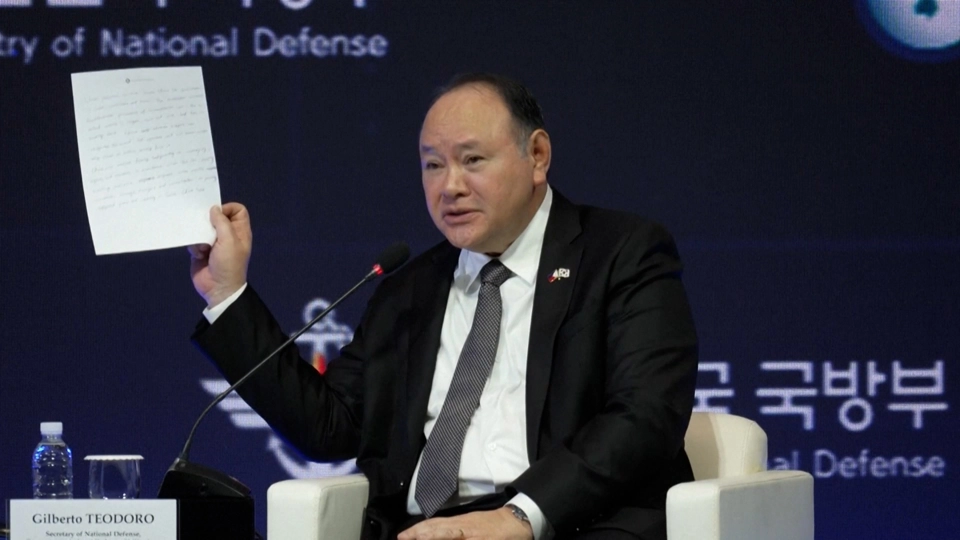 01:02
01:02 02:28
02:28 02:46
02:46 03:14
03:14 02:24
02:24 00:33
00:33 03:22
03:22 02:37
02:37