China’s Ethnic Unity Law
REPORTER:
China’s controversial new ethnic unity law, passed earlier this year, has just gone into effect, raising international concern, including in Taiwan.
The law effectively aims to assimilate the country’s 55 recognized minority ethnic groups around a single Chinese identity. More broadly, it also says that anyone who undermines ethnic unity and progress can be punished, including people outside the country, who can be held legally responsible for so-called ethnic separatism.
China claims Taiwan as part of its territory. It considers anyone who rejects this claim, including Taiwan’s president, a separatist.
Analysts say this law could give Beijing more legal basis to target Taiwanese people it sees as advocating for independence.
Tzeng Wei-feng (ASSOCIATE RESEARCH FELLOW, INSTITUTE OF INTERNATIONAL RELATIONS, NCCU):
The law incorporates the idea of national unification. Anything that could undermine unification is effectively treated as undermining ethnic unity. Taiwanese people may worry that stating that they don’t support unification or saying anything that could be seen as undermining unification would violate this law.
REPORTER:
One part of the law even explicitly mentions Taiwan. It says China is working to deepen cross-strait integration and to get more Taiwanese people to identify as Chinese.
Even if Beijing never uses the law to take real action, it could still have an impact on freedoms.
Arthur Wang (CENTRAL POLICE UNIVERSITY):
People will be afraid to speak about certain issues or take certain actions. Because you never know when China might use this law to punish you. I believe this psychological toll and chilling effect could be among the most terrifying consequences of this law.
REPORTER:
Given the law’s overseas provision, there’s also a risk it could be used against people from other countries who advocate for Taiwan or say anything Beijing sees as undermining Chinese ethnic unity.
Arthur Wang (CENTRAL POLICE UNIVERSITY):
Of course, there’s still a question of whether [China] can actually arrest people [abroad]. But if China announcing to the international community that it’s issuing a notice for someone’s arrest because of things like undermining ethnic unity or supporting Taiwan, Xinjiang, Tibet or Hong Kong inevitably will create a sense of pressure for many people.
REPORTER:
Taiwan’s government says China’s goal with this law is to intimidate. But it also says this isn’t going to change much for Taiwanese people.
Liang Wen-chieh (SPOKESPERSON, MAINLAND AFFAIRS COUNCIL):
For Taiwanese people the reality is that even without this law the Chinese Communist Party could still pin any charge it wants on us. With or without this law [Taiwanese people] face the same risks when traveling to mainland China.
REPORTER:
China’s Ethnic Unity Law
REPORTER:
China’s controversial new ethnic unity law, passed earlier this year, has just gone into effect, raising international concern, including in Taiwan.
The law effectively aims to assimilate the country’s 55 recognized minority ethnic groups around a single Chinese identity. More broadly, it also says that anyone who undermines ethnic unity and progress can be punished, including people outside the country, who can be held legally responsible for so-called ethnic separatism.
China claims Taiwan as part of its territory. It considers anyone who rejects this claim, including Taiwan’s president, a separatist.
Analysts say this law could give Beijing more legal basis to target Taiwanese people it sees as advocating for independence.
Tzeng Wei-feng (ASSOCIATE RESEARCH FELLOW, INSTITUTE OF INTERNATIONAL RELATIONS, NCCU):
The law incorporates the idea of national unification. Anything that could undermine unification is effectively treated as undermining ethnic unity. Taiwanese people may worry that stating that they don’t support unification or saying anything that could be seen as undermining unification would violate this law.
REPORTER:
One part of the law even explicitly mentions Taiwan. It says China is working to deepen cross-strait integration and to get more Taiwanese people to identify as Chinese.
Even if Beijing never uses the law to take real action, it could still have an impact on freedoms.
Arthur Wang (CENTRAL POLICE UNIVERSITY):
People will be afraid to speak about certain issues or take certain actions. Because you never know when China might use this law to punish you. I believe this psychological toll and chilling effect could be among the most terrifying consequences of this law.
REPORTER:
Given the law’s overseas provision, there’s also a risk it could be used against people from other countries who advocate for Taiwan or say anything Beijing sees as undermining Chinese ethnic unity.
Arthur Wang (CENTRAL POLICE UNIVERSITY):
Of course, there’s still a question of whether [China] can actually arrest people [abroad]. But if China announcing to the international community that it’s issuing a notice for someone’s arrest because of things like undermining ethnic unity or supporting Taiwan, Xinjiang, Tibet or Hong Kong inevitably will create a sense of pressure for many people.
REPORTER:
Taiwan’s government says China’s goal with this law is to intimidate. But it also says this isn’t going to change much for Taiwanese people.
Liang Wen-chieh (SPOKESPERSON, MAINLAND AFFAIRS COUNCIL):
For Taiwanese people the reality is that even without this law the Chinese Communist Party could still pin any charge it wants on us. With or without this law [Taiwanese people] face the same risks when traveling to mainland China.
REPORTER:
China already has other regulations targeting Taiwanese people it sees as advocating for independence, including allowing the death penalty for those it labels “diehard” separatists.
How China actually uses the law will remain to be seen. Enforcing it could be difficult if other countries refuse extradition requests.
But analysts say the law could still discourage open debate and criticism of issues concerning China, not just within the country’s borders, but anywhere in the world.China already has other regulations targeting Taiwanese people it sees as advocating for independence, including allowing the death penalty for those it labels “diehard” separatists.
How China actually uses the law will remain to be seen. Enforcing it could be difficult if other countries refuse extradition requests.
But analysts say the law could still discourage open debate and criticism of issues concerning China, not just within the country’s borders, but anywhere in the world.
 03:34
03:34 00:31
00:31 00:35
00:35 00:42
00:42 02:54
02:54 00:52
00:52 02:33
02:33 04:03
04:03 03:00
03:00 01:12
01:12 02:27
02:27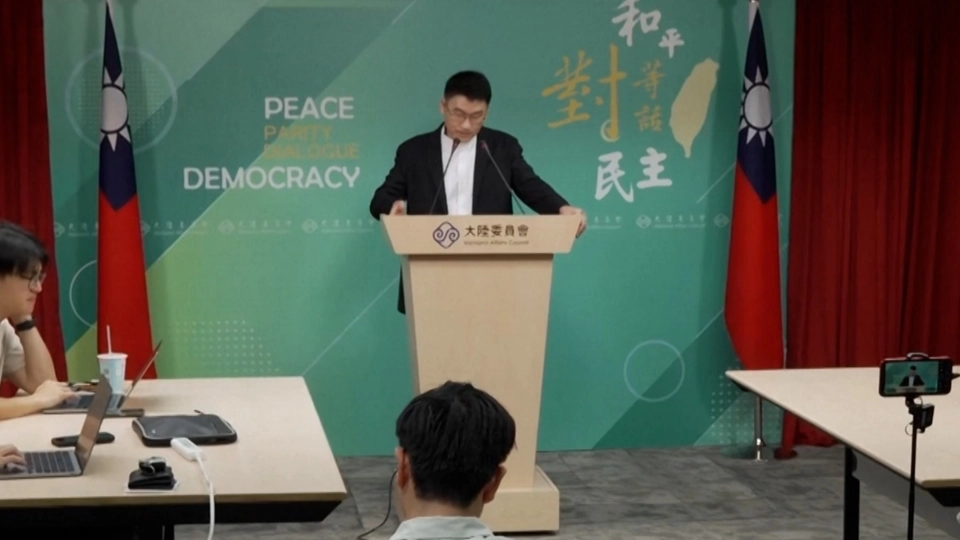 02:16
02:16 00:34
00:34 00:26
00:26 00:34
00:34 03:21
03:21