Middle East Conflict Escalates as US, Israel, and Iran Trade Strikes
REPORTER:
The death toll is rising in the Middle East as the US and Israel continue to trade strikes with Iran. As more countries are drawn in, oil prices are spiking, travel chaos is growing, and threats to civilian lives remain.
Smoke rises over Tehran Sunday evening, evidence of a new US or Israeli strike. Iran’s supreme leader and many of the country’s top officials are confirmed dead. US President Donald Trump now says he’s willing to go back to talks but that the conflict could go on for up to a month—and grow deadlier.
We pray for the full recovery of the wounded and send our immense love and eternal gratitude to the families of the fallen. And sadly, there will likely be more. Before it ends, that's the way it is.
But as Iran strikes back and missiles crisscross the region, the number of countries involved in this conflict is growing, and the consequences are global.
First there’s Israel, a partner in the strikes on Iran that’s seen Iranian retaliation. Here in Jerusalem, five people were wounded Sunday in a missile attack. At least nine people in central Israel also died. Israel, like the US, is concerned about Iran’s missiles, and what it believes are Iranian attempts to build nuclear weapons. For now, Israeli Prime Minister Benjamin Netanyahu doesn’t seem to be looking to de-escalate.
Benjamin Netanyahu (PRIME MINISTER):
This combination of forces enables us to do what I have long hoped to do for 40 years – to strike the terror regime decisively.
Then there are Arab States—Iran's neighbors, where Iranian missiles have hit US military targets, but also civilian buildings like this one in Bahrain. Even beyond the Gulf, condemnation has come from countries like Syria and Jordan—whose information ministers have met over Iran’s counterattacks.
Jordanian Information Minister:
I reiterate, in light of the ongoing regional events, our strongest condemnation of the targeting of Jordanian territory by Iranian missiles, as well as the targeting of the territories of other brotherly Arab states.
And Europe’s getting involved, too. Germany, France and the UK say they’re joining the US and Middle Eastern allies to destroy Iran’s missile and drone capabilities at the source.
The stakes for everyone are high. Iran’s Navy has effectively choked off this narrow waterway, the Strait of Hormuz, the transit point for more than 20% of the world’s oil.
Most shipments have stopped, and Brent crude prices have already jumped 10%.
There’s travel chaos, too. This terminal at Riyadh’s airport was largely deserted Sunday as flights to the Middle East are cancelled, and other flights reroute to avoid the region’s airspace.
And far more civilian lives are at risk, as the death toll from the strikes climbs. The town of Minab in southern Iran is still in shock at an attack that hit an all-girls’ elementary school, killing at least 165 people.
With the region now on high alert, and fears of a broader conflict growing, how this all ends is an open question.
 02:15
02:15 03:07
03:07 03:23
03:23 03:25
03:25 03:23
03:23 02:42
02:42 02:54
02:54 02:56
02:56 03:24
03:24 02:33
02:33 00:27
00:27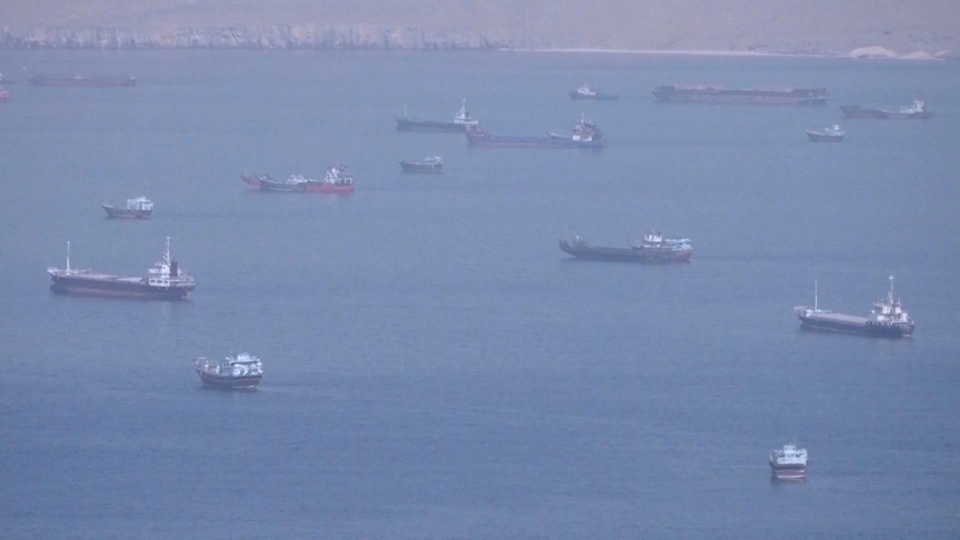 00:30
00:30 02:36
02:36 00:33
00:33 02:50
02:50 03:09
03:09