In the foothills of Eastern Taiwan, one Indigenous farmer is bringing an ancestral crop back to life.
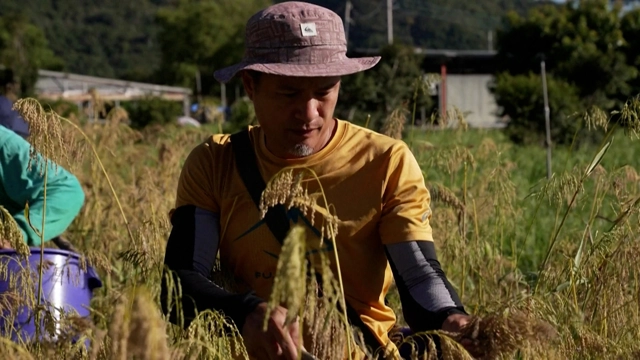
For more than a decade, Bunun farmer Banu Ismahasan and his parents have been hard at work in the fields.
BANU ISMAHASAN, BUNUN FARMER: "Because we didn't know it and it didn't know this land or us. With just a single panicle of grain we carefully handled it and planted it till what we have now."
This is Taiwan oil millet, an endemic grain.
Indigenous communities harvested this hardy crop for generations.
But by the 1960s, it had largely disappeared from local diets in favor of rice, a cheaper and less labor-intensive alternative.
Today, with its tiny grains and slim gains, it's not an obvious choice for local farmers.
But Ismahasan says the true value of the humble Taiwan oil millet lies not in its taste, but in its remarkable resilience.
BANU ISMAHASAN, BUNUN FARMER: "In 2022, we were growing Taiwan oil millet over here and the rest of this field was planted with foxtail millet. When rust disease hit we lost the entire foxtail millet crop nearly 0.8 hectares. But the Taiwan oil millet was fine. And when a typhoon came almost all the foxtail millet got soaked and started sprouting right on the seed heads. The Taiwan oil millet didn't."
As Ismahasan's ancestors learned long ago, Taiwan oil millet can weather typhoons, droughts and diseases.
And today, when stored correctly at sub-zero temperatures, its seeds can last for decades.
Experts say these resistant properties could be increasingly valuable as climate change threatens food security around the world.
LIN YEN-YU, ASSISTANT RESEARCHER, NAT'L PLANT GENETIC RESOURCES CENTER: "Given current farming practices industry needs and policy priorities Taiwan oil millet isn't yet ready for large-scale commercial cultivation. We believe this still needs to be conserved because it remains an important plant genetic resource. In the future, as farming practices change or the climate shifts further its value may begin to be recognized and explored."
But for Banu Ismahasan, bringing back Taiwan oil millet is about more than its potential as a climate-resilient crop.
It's about keeping Indigenous food traditions alive.
BANU ISMAHASAN, BUNUN FARMER: "I think our first priority should be to get people in our community growing and eating it again to bring it back into our everyday lives just as it was for our elders. Because if we don't even eat it ourselves anymore how can we expect to turn it into a viable business?"
In the face of a changing climate, Ismahasan is showing how we can look to the past to cultivate a sustainable future.
Eason Chen, Hollie Younger and Andrew Ryan for TaiwanPlus.
 03:12
 04:05
 02:43
 03:18
 02:32
 00:36
 04:11
 01:13
 03:09
 02:07
 00:36
 00:36
 00:44
 05:23
 04:40
 01:31